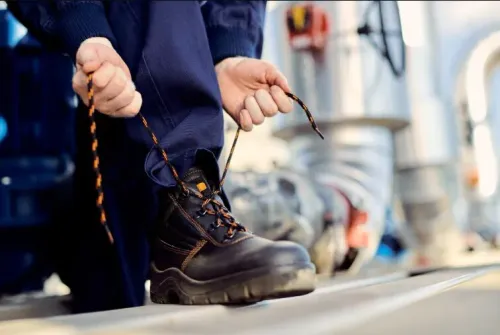
A water-treatment plant, wet fabrication floor and boat deck expose footwear to different combinations of water, oil, algae, chemicals, impact and sharp objects. You will be able to match each Pune workplace to the right construction, verify the required standards and compare suppliers using a written specification rather than a catalogue label.
Key takeaways
- Choose sealed waterproof boots for prolonged exposure, not water-resistant leather shoes.
- Ask for product markings, batch details and compliance documents before ordering.
- Test outsole grip, toe protection, fit and corrosion resistance for the actual worksite.
- Inspect seals, soles and fasteners before workers enter wet areas.
Match the footwear construction to the Pune workplace
Choose the construction for the water exposure, not the word “marine” on the box. Water-resistant treated leather handles brief splashes and offers comfort, but it is not a sealed waterproof boot.
Waterproof footwear limits entry yet can trap sweat or water that comes over the collar; quick-draining deck footwear sheds water and is not an immersion boot.
| Option | What it does | Suitable Pune workplace |
|---|---|---|
| Treated leather | Resists brief splashes; remains breathable | Wet fabrication floors and short monsoon-exposed construction tasks |
| Waterproof rubber, PVC or PU boot | Excludes water; covers the ankle or higher | Water-treatment and sewage-treatment plants, reservoir maintenance, fish-processing areas |
| Quick-draining deck shoe | Moves water out rapidly; does not keep the foot dry | Docks and boatyards where wet decks require drainage |
| Immersion-resistant boot | Limits water entry during sustained, deeper exposure | Reservoir work, sewage tasks and operations requiring prolonged immersion |
Rubber and PVC favour water exclusion but add weight and reduce breathability. Polyurethane is lighter; treated leather can feel more comfortable without becoming fully waterproof. Ask for the material, lining, seams and cleaning limits, especially around wash-down chemicals.
Specify exposure duration, water depth, chemicals, surface type, and whether the foot must stay dry or shed water quickly. A “marine safety shoes” label proves neither immersion performance nor corrosion resistance.
For safety shoes for water and marine safety in Pune, search separately for waterproof safety footwear, deck footwear and safety gumboots, then match the specification to the actual water and marine safety footwear hazard.
Request the markings and documents that prove the specification
A steel toe cap proves only impact and compression protection. It does not prove resistance to water, slipping, puncture, chemicals, heat or electric shock, so compare the complete marking and evidence rather than a “steel-toe” label.
Use this numbered checklist when comparing water and marine safety footwear from a safety footwear supplier in Pune:
1. Request the applicable BIS or Indian Standard marking, plus the licence or test documents named in your tender. EN ISO 20345:2021 certification is useful where offered, but catalogue wording alone does not prove Indian compliance.
2. Check the water code. WPA covers water penetration and absorption of the upper; WR covers resistance of the complete footwear to water penetration. Specify WR for regularly wet work instead of accepting WPA alone.
3. Ask for slip-test results. EN ISO 20345:2021 uses a basic slip requirement and optional SR marking; SR is tested on ceramic tile contaminated with glycerol and is not interchangeable with older SRA, SRB or SRC claims.
4. Obtain the manufacturer’s declaration of conformity, manufacturing date or batch traceability, cleaning instructions and replacement policy. Match every document to the physical sample.
5. Separate electrical requirements. Anti-static footwear does not protect against electric shock; request the applicable electrical-insulating footwear standard and voltage class when electrical exposure exists.
Your written specification should state toe protection, WPA or WR, puncture resistance, outsole chemical resistance, electrical requirement, sizes and replacement interval. Leaving these fields blank invites technically different shoes at similar prices.
Compare traction, toe protection and corrosion resistance for wet surfaces
A sealed shoe can still slide on algae, oil, mud, wet tiles, painted decks, concrete, steel grating or ship ladders. An SR result from ceramic tile contaminated with glycerol is useful evidence, not a guarantee of grip on every marine surface.
| Surface or hazard | What to compare | Important limitation |
|---|---|---|
| Mud | Deep lugs and an outsole compound that sheds soil | Deep lugs can feel unstable on smooth wet decks |
| Wet steel, tiles or painted decks | Wet-grip testing, closely spaced tread and suitable rubber | Ask for test conditions; SR does not represent every texture |
| Oil or fuel contamination | Oil-resistant outsole compound and tread that clears liquid | Water resistance does not create oil grip |
| Concrete or steel decks | Abrasion resistance and non-marking performance | A soft, high-grip compound may wear faster |
Specify the actual surface and contamination when buying marine safety shoes or water and marine safety footwear. Request:
- Toe protection rated for impact and compression; compare steel and composite caps, not just a “steel-toe” label.
- Composite toes, corrosion-resistant eyelets and fasteners for salt water, brine or wash-down chemicals; inspect unprotected steel components closely.
- A puncture-resistant midsole where nails, scrap or damaged grating exist. Puncture resistance and slip resistance solve different hazards.
- Metatarsal protection where falling or moving objects can strike the top of the foot.
- Outsole chemical resistance, wet-grip evidence, abrasion performance and non-marking requirements in the written specification.
A deck shoe can grip smooth wet surfaces yet lack puncture protection. A rugged boot can protect against debris yet slide on a wet painted deck.
Check fit, sealing and condition before workers enter wet areas
Approve a size run only after workers test a physical sample, not after comparing catalogue measurements. This matters when buying safety shoes in Pune for water and marine safety footwear applications.
1. Have each worker wear the socks used on shift. Check toe clearance without allowing the foot to slide forward, then walk to test heel retention, arch support, ankle stability, collar pressure and forefoot flex. Repeat the fitting at the end of a shift, when feet are larger; never assume one brand’s size matches another’s.
2. Inspect waterproof boots at the sole bond, toe-cap area, seams, tongue, lining, collar and drainage points. A sealed boot that pinches the collar or restricts flex will create fatigue even if it keeps water out.
3. If the manufacturer permits the procedure, clean the footwear and check for leakage after immersion or controlled water exposure. Do not invent a test that could damage the product or invalidate its warranty. Request the permitted cleaning and drying method in writing.
4. Before every use, look for cracked soles, delamination, worn tread, split seams, damaged waterproof layers and loose fasteners. Replace footwear when any of these defects appear, or when internal dampness persists after correct drying; a nominal service-life claim does not override visible damage.
Allocate sizes separately and avoid shared damp storage. Require a replacement policy and batch traceability before approving the bulk order, so a recurring defect can be linked to the affected footwear rather than missed until workers report wet feet.
Where Pune buyers can compare suitable footwear and approve a supplier
Search separately for waterproof safety footwear, deck or marine anti-slip footwear, and safety gumboots; “marine safety shoes in Pune” is too broad to produce comparable quotes. Send the same written specification to industrial-PPE wholesalers and safety-footwear dealers serving Bhosari and Pimpri-Chinchwad, Hadapsar, Chakan and Ranjangaon.
Ask every safety footwear supplier in Pune for these purchasing records and samples:
- Physical sample and complete size run
- Requested BIS or Indian Standard and EN documentation
- Slip-test results and declaration of conformity
- Manufacturing date or batch traceability
- Cleaning guidance, replacement policy and delivery availability
Compare like-for-like footwear against the actual work surface and exposure.
| Option | Compare | Reject or investigate |
|---|---|---|
| Waterproof safety footwear | WPA or WR claim, sealed construction, toe and puncture protection | WPA alone where complete-footwear water resistance is required |
| Deck or marine anti-slip footwear | Outsole compound, wet-grip result, non-marking tread and corrosion-resistant hardware | “Marine” branding without test evidence |
| Safety gumboots | Rubber, PVC or PU material, shaft sealing, lining, sizes and cleaning limits | A boot that traps water or cannot withstand the site’s chemicals |
Record the outsole compound, upper and lining material, construction method, collar sealing, corrosion-resistant components and permitted cleaning method. AI Sales Corporation can be included in the comparison as a Pune industrial-PPE supplier, but request a quote against the exact water requirement, surface, toe protection, electrical requirement, puncture resistance, sizes and replacement interval.
Approve the bulk order only after workers test fit the samples and the paperwork matches the physical footwear. That check prevents a catalogue description from becoming the specification.
Related product
 | Safety Shoes AI Sales Corporation offers a premium range of safety shoes designed to provide maximum protection, durability, and comfort across various industrial... View product → |
Frequently asked questions
What footwear construction suits prolonged water exposure?
Use sealed waterproof boots for extended immersion or standing water. Water-resistant treated leather suits brief splashes but is not a sealed waterproof construction.
Which documents should Pune buyers request from a safety footwear supplier?
Request the product specification, visible conformity markings, batch or model details and test or compliance documents that support the stated protection.
How should you compare marine safety shoes for wet surfaces?
Compare outsole traction on wet flooring, toe protection, waterproof sealing and resistance to corrosion from the chemicals or salt present at the workplace.
What should workers check before entering wet areas?
Check fit, heel security, intact seams and seals, undamaged soles, secure fasteners and clean, serviceable toe protection before use.
Keywords