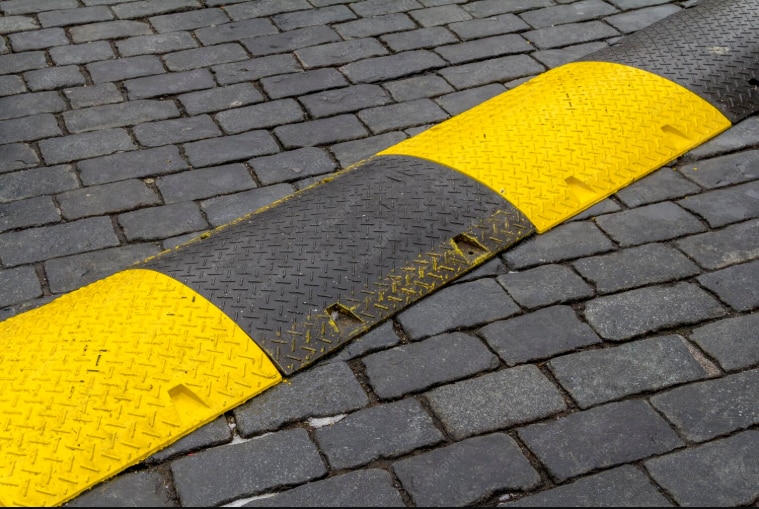
A temporary maintenance site needs a speed-control device that matches its vehicles, pavement and removal schedule—not simply the lightest modular hump available. By checking the AK1005 drawing, load rating, fixing method, weather performance and traffic layout, you can decide whether it belongs in a reusable Pune maintenance kit or should be rejected.
Key takeaways
- Match the bump to vehicle class and the speed you need to control.
- Request AK1005 dimensions, material, load rating and reflective-panel details.
- Use approved anchors and inspect pavement before drilling or removing the bump.
- Test vans, forklifts and emergency access during Pune monsoon conditions.
Start with vehicle class and the speed you need to control
Vehicle class and target speed decide whether a modular bump belongs at the site. A light-duty unit intended for cars is not automatically safe under a loaded maintenance van, forklift, rigid truck or bus.
Select a plastic speed bump for maintenance kit worksite in Pune only after matching its stated load rating and fixing method to the heaviest vehicle that will cross it.
| Vehicle class | Practical target speed | Suitability decision |
|---|---|---|
| Two-wheelers | 10–15 km/h | Do not force them over a tall module; provide a separate, clearly marked route if stability is a concern. |
| Cars | 10–20 km/h | Usually the most suitable class for a light-duty modular hump, subject to the product rating. |
| Forklifts | Walking pace, about 5–10 km/h | Use only when the manufacturer confirms forklift loading and the hump will not destabilise the load. |
| Maintenance vans | 10–15 km/h | Confirm axle load, ground clearance and approach angle before selection. |
| Rigid trucks or buses | Below 15 km/h | Reject a light-duty unit unless a documented truck load rating covers the vehicle. |
A speed bump for maintenance areas controls already-slow traffic; it is not a substitute for signs, cones, barriers or pedestrian separation. Use it where drivers can approach at a controlled speed, with clear sight distance.
The 100 mm-high, approximately 3.7 m-wide road-breaker reference targets about 25 km/h, but that geometry does not prove an AK1005 modular product has the same effect. Never infer suitability from the product name alone.
Demand the AK1005 dimensions and material specification
A code alone is not a specification. A search for plastic speed bumps ak1005 in pune should end with a drawing and datasheet, not a purchase based on the product name.
| Detail | Demand from the supplier | Why it matters |
|---|---|---|
| Overall dimensions | State installed height, width, total length, and tolerance in millimetres | Height determines the vehicle impact and clearance |
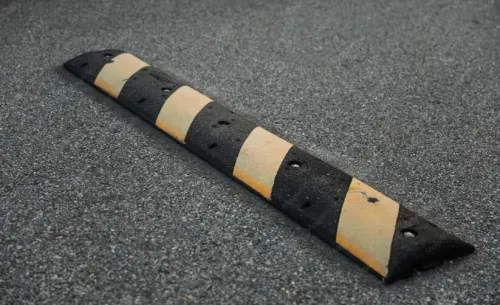
| Module construction | Show centre-module length, number of modules, ramp angle, end-piece shape, caps, and transition detail | A raised edge or mismatched joint catches tyres, trolleys, and pallet equipment |
| Vehicle performance | Name the permitted vehicle classes and rated approach speed; require separate load ratings for cars, vans, forklifts, rigid trucks, and buses | A car-rated hump can deform or loosen under truck axle loads |
| Material | Identify the polymer or rubber compound, density, hardness, recycled content, and maximum wheel or axle load | “Plastic” does not prove strength or service life |
| Surface and weather performance | Provide wet-grip data, reflective-element specification, UV-resistance evidence, rain drainage performance, and minimum and maximum operating temperatures | Smooth material loses braking effect in rain, while UV damage makes modules brittle |
Ask for the unit weight and dimensional tolerances too. Confirm the drawing shows every bolt recess and replacement end section. Reject a quote that gives only “AK1005” without load testing, speed guidance, material composition, or a temperature range.
Check anchoring, removal and pavement damage before deployment
A speed bump for maintenance areas must be anchored to a surface that can hold the fasteners, not merely covered with loose asphalt or placed on compacted soil. Confirm the vehicle class and manufacturer load rating first; a unit for cars is not suitable for loaded forklifts, maintenance vans or rigid trucks without written approval.
1. Close the route and mark the centreline. Remove dust, oil, standing water and loose aggregate, then inspect for cracks and confirm that concrete thickness suits the specified anchors. Do not drill into weak, cracked or regularly waterlogged concrete.
2. Lay the centre and end modules in sequence, keeping each joint tight and the transition flush. Use the manufacturer’s anchor type, hole diameter, embedment depth and tightening torque. Never accept a raised outer edge, exposed bolt, missing end cap or mismatched module.
3. Check drainage before opening the route. The installed speed bump must not cover a drain, trap water at the entrance or push runoff across a pedestrian path; test the layout with a hose if rain is absent.
4. To remove it, isolate the route, loosen the specified fasteners and lift modules rather than dragging them across the pavement. Bag and label bolts, inspect every section, and repair or plug anchor holes to prevent water entry and trip points.
5. Reinspect after the first vehicle movements and after any layout change. A plastic speed bump for maintenance kit worksite in Pune needs cones, warning signs and a defined route, not anchoring alone.
Fit the bump into Pune monsoon and worksite traffic control
Use the bump only where vehicles already approach at low speed and the route remains wide, visible and predictable. Good worksite traffic control in Pune requires a defined vehicle lane, a separate pedestrian path and enough approach distance for drivers to see the hump before reaching it.
Review the control point whenever the maintenance layout changes, especially after adding:
- Temporary barriers or cones that narrow the approach
- Parked vehicles that block sight distance
- Excavations, cable ramps or hoses across the route
- Stored materials that push pedestrians into vehicle traffic
A modular bump cannot correct a badly arranged work zone. Add advance warning signs, continuous barriers where pedestrians need protection, reflective markings and lighting for night work; keep the target speed low enough for controlled passage rather than relying on the hump to stop fast vehicles.
Pune’s monsoon makes drainage part of the installation test. Do not place the unit over a drain, create a lip that retains water at the entrance or direct runoff across a walking route. Inspect the layout during rain, or run a hose over it, before acceptance.
Check the pavement again after heavy rain. Remove dust, oil and standing water, and reject cracked concrete or a surface too thin to hold the anchors. Waterlogged or weak concrete can release the fixings while the plastic remains undamaged. Recheck signs, barriers, visibility and pedestrian separation whenever the worksite moves.
Use a supplier checklist and a practical acceptance test
Ask for a drawing, material specification, fixing detail and acceptance criteria before paying for a modular unit. The code AK1005 is not a national dimensional or performance standard, so a plastic speed bump supplier in Pune must identify the actual product.
1. Request the height, total width, module length, centre and end-piece configuration, material composition, unit weight, permissible vehicle class, target speed, load rating, UV and rain performance, temperature range, and anchor type. Ask for a sample or drawing showing every transition.
2. Check the proposed location before drilling. Reject surfaces covered in oil, dust or standing water, and investigate cracks or weak concrete; failed anchors can leave an intact bump moving under tyres. Confirm that the layout does not cover a drain, trap monsoon water or direct runoff across a pedestrian route.
3. After installation, inspect every joint and end cap by hand and sight. Do not accept a raised outer edge, exposed bolt, mismatched module or loose section. Push and drive a maintenance vehicle over it at the planned low approach speed, then retighten or reject any movement, rocking or anchor pull-out.
4. Test drainage with a hose or during rain. Walk the pedestrian route and push a hand trolley across the controlled area; remove the unit from service if water ponds, wheels catch an edge or people are forced into the vehicle lane.
AI Sales Corporation can be one supplier against which to compare drawings and fixing details, not a substitute for this site test. Recheck the control point after barriers, parked vehicles, excavations, cable ramps or stored materials change the approach.
Keep signs, cones, segregation and night visibility in place: plastic speed bumps AK1005 support worksite traffic control in Pune but do not replace it.
Related product
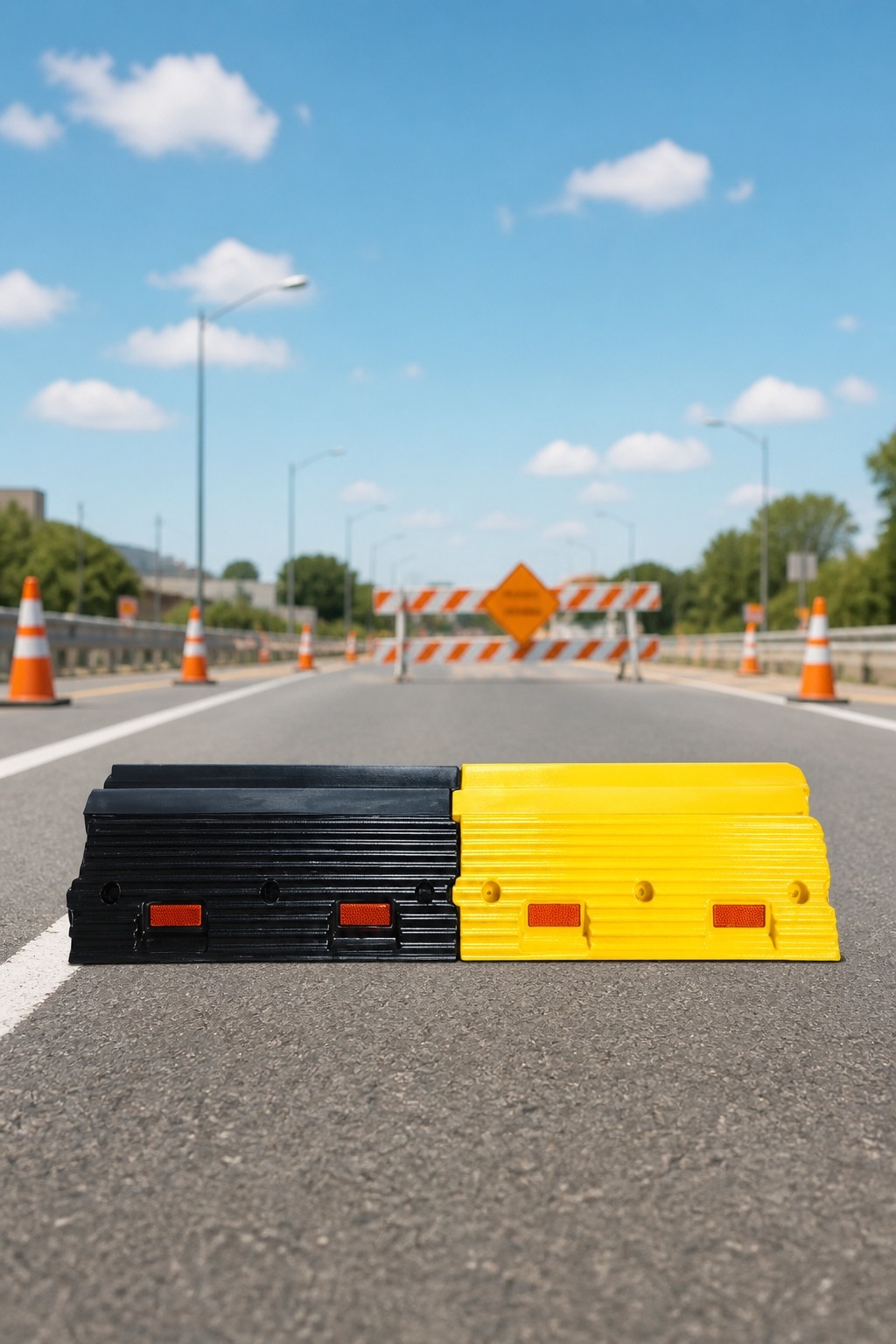 | Traffic Safety Equipments Durable Traffic Safety Solution in Pune AI Sales Corporation, Pune offers high-quality Plastic Speed Bumps AK1005, designed to effectively control... View product → |
Frequently asked questions
How do you choose a plastic speed bump for a maintenance worksite?
Start with the heaviest vehicle using the route, including loaded vans, forklifts, rigid trucks and buses. Then select a bump designed for that vehicle class and the target speed, rather than choosing by appearance alone.
What AK1005 details should you verify before buying plastic speed bumps in Pune?
Ask for the AK1005 length, width, height, module weight, material specification, load rating, surface profile, reflective markings and joining method. Record these details on the purchase or inspection document.
How should you anchor and remove a plastic speed bump?
Confirm the anchor type and pavement condition before installation. Mark utilities, drill to the specified depth, use the correct fixings and retain removal instructions so the surface is not unnecessarily damaged.
How can you test a speed bump for Pune monsoon and worksite traffic control?
Inspect drainage, visibility and surface grip, then run a controlled test with the actual site vehicles. Check for movement, rocking, standing water, damaged anchors and safe access for pedestrians and emergency vehicles.
Keywords