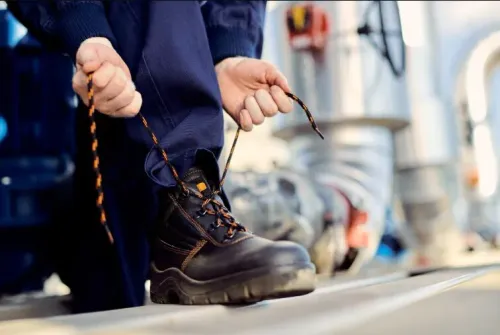
Safety shoes can reduce slips, trips and foot injuries, but they do not arrest a worker falling from a ladder, platform or roof. By separating footwear functions from fall-protection systems, electrical-hazard ratings and workplace conditions, you can specify shoes that match the risks in your Pune site without relying on an unsafe product claim.
Key takeaways
- Safety shoes do not arrest falls from roofs, ladders, platforms or cable trays.
- Choose EH, dielectric, conductive or antistatic footwear for the actual electrical hazard.
- Check the complete shoe, including outsole, seams, tongue, label and certification documents.
- Trial footwear on the real floor before buying industrial safety shoes in Pune.
What safety shoes protect you from—and what they cannot arrest
No. Safety shoes do not arrest a fall from a roof, platform, ladder or cable tray. They reduce same-level slips and trips through outsole grip, stable footing and ankle support, but they are not a substitute for guardrails, scaffold protection or a fall-arrest system.
A 200-joule toe-cap rating protects toes from a falling or rolling object; it does not stop your body falling. A shoe’s penetration resistance protects against sharp objects underfoot, while its electrical-hazard rating addresses a defined test condition, not every live-circuit exposure.
Treat fall protection safety shoes as footwear for footing and impact control, never as a harness.
A height-fall system requires all three parts to work together:
- An anchorage that can withstand the required fall-arrest load
- Body support from a full-body harness
- A connecting subsystem, such as an energy-absorbing lanyard or self-retracting lifeline
For safety shoes for fall protection electrical workplaces in pune, keep electrical isolation, absence-of-voltage verification and the required electrical protective equipment in place. Dielectric or EH footwear is secondary protection, not permission to work energised.
Fit also affects fall risk. A loose heel or unstable sole increases slipping; an overly tight toe box encourages early removal. Trial the shoe with work socks and approved orthotic inserts, because an unapproved insert can alter tested electrical or impact performance.
Compare EH, dielectric, conductive and antistatic footwear by function
The four labels describe different electrical behaviours, not interchangeable levels of protection. EH-rated footwear resists accidental electrical contact as secondary protection; dielectric footwear provides tested insulation; conductive footwear carries static charge away; antistatic or ESD footwear dissipates it in a controlled range.
| Option | Electrical function | Correct use |
|---|---|---|
| EH-rated | Resists electrical passage during accidental contact with energised circuits | Use only as secondary protection alongside isolation, voltage verification and required electrical PPE |
| Dielectric | Insulates the wearer from ground at the tested voltage and conditions stated by the manufacturer | Use where electrical insulation is the task; check the test marking, voltage rating and dry-use limits |
| Conductive | Provides a low-resistance path from the body to ground | Use for static control where contact with energised circuits is not a hazard |
| Antistatic or ESD | Releases static charge gradually while limiting sudden discharge | Use around electronics, flammable materials or explosive atmospheres when the site specifies ESD control |
Never substitute conductive or ESD footwear for EH or dielectric footwear. A low-resistance path that safely removes static can increase shock risk near live equipment.
Also separate electrical protection from the phrase fall protection safety shoes. Tread and slip resistance help prevent a same-level slip, but no footwear arrests a fall from a ladder, platform or roof. Use guardrails, a full-body harness, anchorage and an energy-absorbing lanyard or self-retracting lifeline for height work.
A toe-cap rating protects against impact, not falling from height.
Match the shoe to Pune’s floors, voltage exposure and site hazards
Specify footwear by task and floor, not by the label “fall protection safety shoes.” An indoor panel room needs a toe cap, penetration resistance and slip grip, plus EH or dielectric protection selected against the voltage, fault energy and expected step or touch potential. Isolation and voltage verification remain essential.
| Location | Selection focus | Do not assume |
|---|---|---|
| Indoor panels | Electrical-hazard or dielectric footwear, slip-resistant outsole, toe and puncture protection | An EH marking controls arc flash or high fault current |
| Switchyards | Weather-resistant construction, aggressive wet-grip outsole, toe protection and the electrical property required by the risk assessment | Water resistance equals electrical insulation |
| Cable trays | Flexible sole, secure heel, penetration resistance and stable tread for narrow or uneven footing | Footwear prevents a fall after you leave the walking surface |
| Ladders | Firm heel retention, defined heel or ladder-compatible sole and slip resistance | A shoe replaces three-point contact, a guardrail or fall-arrest system |
| Wet or oily floors | Outsole tested for the actual contaminant—water, oil or process liquid—and a closure that limits liquid entry | Electrical rating proves slip resistance |
For electrical workplace safety shoes, do not substitute conductive or antistatic footwear for EH or dielectric footwear. Conductive shoes discharge static through a low-resistance path; antistatic or ESD shoes manage charge without providing the same electrical resistance. Choose the property your task requires.
Check separate evidence for insulation, slip, impact, compression and puncture performance. Safety shoes in Pune must also suit monsoon wash-downs, chemicals and heat found at the site. No shoe arrests a height fall; use a harness, lanyard, lifeline, guardrail or scaffold control where the assessment requires it.
Check the complete shoe, not just the toe cap or marketing claim
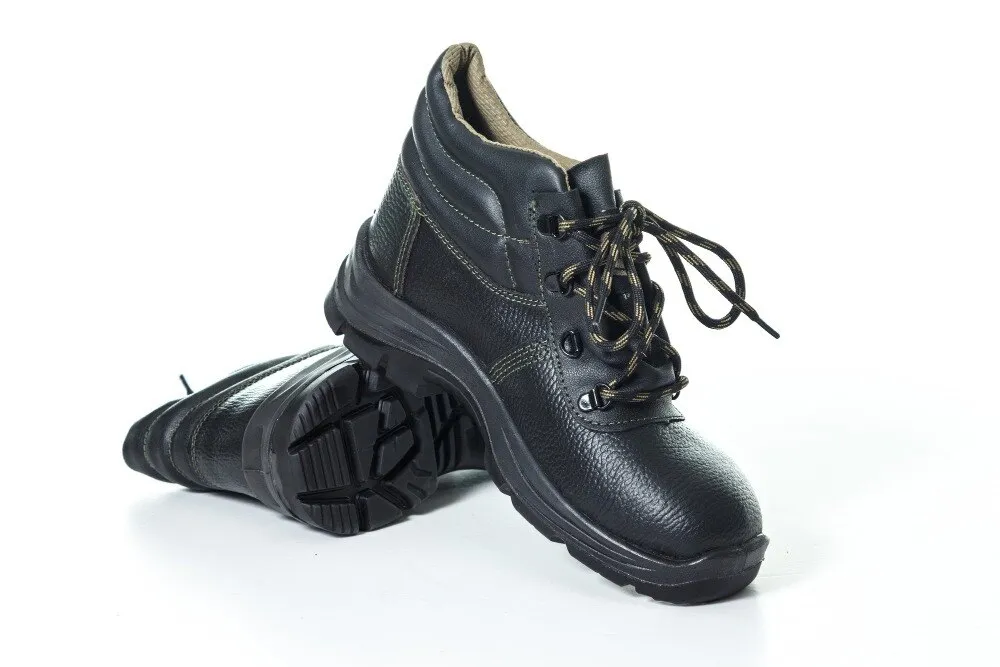
A genuine protection claim belongs to the complete, traceable shoe, not merely its toe cap. Check the tongue, lining or outsole for durable marking of the manufacturer, model, size, applicable standard such as the IS 15298 series, and electrical classification where claimed.
| Claim | Evidence to check | What it does not prove |
|---|---|---|
| Toe impact or compression | Tested toe-cap rating stated for the exact model | Protection from falling off a ladder or platform |
| Puncture resistance | Marked midsole construction and test documentation | Slip resistance or electrical insulation |
| Electrical hazard or dielectric | Manufacturer marking, test standard and exact-model report | Permission to work on energised equipment |
| Slip resistance | Declared test result for the outsole and stated contaminant | Protection from electrical contact |
| Antistatic or ESD | Resistance range and use instructions | Dielectric protection |
For wholesale safety shoes in Pune, reject a carton that says only “ISI certified,” “shock proof” or “anti-fall.” Ask for:
- A declaration of conformity naming the exact model, standard, ratings and manufacturer.
- Batch or lot traceability matching the invoice and delivered pairs.
- Instructions identifying limits, cleaning restrictions and electrical-use conditions.
- A visible, durable size and model mark; compare it with the box and test report.
- An outsole with a defined tread and compound, plus intact bonding, stitching, eyelets and heel construction.
Industrial safety shoes in Pune need slip evidence for the actual floor contaminant—water, oil or process liquid. A steel toe, puncture-resistant midsole or electrical rating proves none of that.
Trial, inspect and procure footwear that workers will keep wearing
Run a wearer trial before placing a bulk order. A shoe that pinches, slips at the heel or overheats will be left in the locker, regardless of its rating.
1. Fit each worker with the socks used on site, then test both shoes near the end of a shift. Check toe clearance, heel retention, arch pressure and side compression while walking, climbing stairs, squatting and standing on a ladder.
Reject pairs that cause rubbing, numbness, heel lift or contact between toes and the toe cap.
2. Define the order by measurable acceptance criteria. Require permanent or durable marking for the manufacturer, model, size, applicable Indian or international standard, electrical classification where claimed, and batch or lot number.
Request the manufacturer’s instructions, declaration of conformity and test report for that exact model—not a generic “ISI certified,” “shock proof” or “anti-fall” catalogue claim.
3. Preserve the tested electrical construction after delivery. Keep footwear dry and free from oil, conductive dust and metal fragments; remove pairs with cuts, exposed components, damaged outsoles or embedded metal. Prohibit drilling, trimming, unauthorised resoling and replacement of the tested insole. Electrical-hazard or dielectric footwear is secondary protection, not permission to work energised.
4. Record replacement triggers and inspect before each use. AI Sales Corporation can help a Pune buyer compare documented model-level evidence rather than accepting a broad catalogue description.
For industrial safety shoes in Pune, a purchase specification should state that safety shoes for fall protection electrical workplaces in Pune prevent slips and foot injuries; they do not arrest a height fall. Use a harness, anchorage and connecting system where fall arrest is required.
Related product
 | Safety Shoes AI Sales Corporation offers a premium range of safety shoes designed to provide maximum protection, durability, and comfort across various industrial... View product → |
Frequently asked questions
Do safety shoes provide fall protection in electrical workplaces?
No. Safety shoes reduce slips, trips and foot injuries, but they do not arrest falls from roofs, platforms, ladders or cable trays. Use guardrails, scaffold protection or a fall-arrest system for work at height.
What is the difference between EH, dielectric, conductive and antistatic footwear?
EH footwear is designed to reduce electrical shock risk under specified test conditions. Dielectric footwear provides insulation from electrical contact when the product is rated and used as instructed. Conductive footwear dissipates static through a low-resistance path, while antistatic footwear controls static buildup without providing fall-arrest protection or a guarantee against electric shock.
How should you choose safety shoes for Pune electrical workplaces?
Match the footwear to the voltage exposure, floor surface, moisture, oil, dust, chemicals, sharp objects and temperature at the site. Confirm the shoe's complete construction and rating rather than relying only on a toe-cap label or sales claim.
What should you inspect before buying electrical workplace safety shoes?
Check the product label, standard or test information, size range, toe protection, outsole grip, electrical rating, stitching, seams, tongue, insole and sole bonding. Ask for traceable product and batch information, then trial the shoes on the working floor.
Keywords