“Virtual protective eyewear” can describe a product name, a digital try-on tool, or AR/VR equipment, so you must identify its physical protection claims before pairing it with hearing protection. By checking hazard coverage, certification markings, attenuation data, fit, and PPE interference, you can specify a combination that protects workers without undermining visibility, hearing, or communication.
Key takeaways
- Define whether virtual eyewear is software, AR hardware, or physical eye protection.
- Match lens markings to impact, chemical, dust, radiation, and splash hazards.
- Use exposure measurements and NRR or SNR data to select ear protection.
- Test eyewear, hearing protection, helmets, and communication headsets as one system.
What Does “Virtual Protective Eyewear” Actually Protect Against?
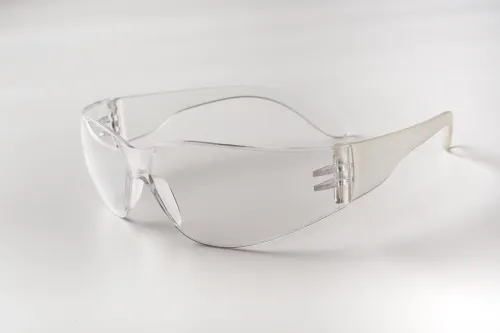
Treat “virtual protective eyewear” as an undefined label until you identify the physical function behind it. It might mean a virtual try-on tool, a digital product-selection feature, augmented-reality or virtual-reality hardware, or a real industrial lens and frame sold under that name.
Only the last category can serve as industrial eye protection when its physical product and markings establish the claimed protection.
- Ask what the item actually does: select eyewear online, display digital information, or block a workplace hazard.
- Name the hazard it controls: impact and flying particles, dust, chemical splash, molten-metal splash, high heat, or optical radiation.
- Confirm the construction: open safety spectacles, sealed goggles, over-spectacles, or a face shield. Each leaves a different area exposed; spectacles do not seal against dust or splash, while a face shield does not seal the eyes.
- Check the product or packaging for the applicable eye-protection standard, performance markings, manufacturer or model identification, and instructions. “Protective eyewear” alone proves none of these claims.
Ordinary prescription spectacles are not a substitute because they lack reliable side protection and do not establish impact, dust, or chemical-splash performance. Specify prescription safety spectacles, over-the-glasses goggles, or a compatible prescription insert.
Add sealed goggles or a face shield when the hazard reaches around spectacle lenses or threatens the face, then test the complete PPE combination for fit and visibility.
Match the Eyewear Construction and Markings to the Hazard
A “virtual protective eyewear” label proves nothing about industrial protection. Select the physical construction and verify the marking on the lens, frame, or packaging against the hazard assessment. Ordinary prescription spectacles leave gaps at the sides; use prescription safety spectacles, over-spectacles, or a compatible insert.
| Option | Construction and marking to verify | Hazard controlled and limitation |
|---|---|---|
| Safety spectacles | ANSI/ISEA Z87.1; Z87 basic impact or Z87+ high impact; manufacturer mark and model identification | Flying particles and impact. They do not seal against dust or liquid splash. |
| Sealed goggles | Indirect-vented or non-vented design; applicable ANSI marking such as D3 for droplets, D4 for dust, or D5 for fine dust | Chemical splash, dust, or fine particles. Direct vents reduce fogging but allow entry. |
| Face shield over eyewear | Standard and impact marking confirmed on the shield | Molten-metal splash, face impact, and heat exposure. It does not replace sealed eye protection. |
| Radiation eyewear | Confirm the filter code, shade number, UV or infrared marking, and wavelength range | Welding arc, ultraviolet, infrared, or laser exposure. A clear lens claiming “UV protection” is not a welding or laser filter. |
| Molten-metal eyewear | Confirm the applicable standard and marking, such as EN 166 code 9 where specified | Molten-metal splash and hot solids. Match the shield, goggles, and clothing to the metal process. |
For safety goggles for wholesale, request the declaration of conformity or test report and compare its model number with every carton. Reject products showing only “protective eyewear” without a standard, manufacturer identification, and hazard-specific marking.
Choose Ear Safety Products from Exposure and Attenuation Data
Noise level is only half the decision. Choose a protector that workers will wear correctly for the entire exposure: plugs suit tight spaces and helmets, while earmuffs suit intermittent tasks and are easier to inspect. A poor seal defeats a higher catalogue rating.
| Option | Choose it when | Main limitation |
|---|---|---|
| Disposable plugs | Hygiene, shared workforces, or dirty conditions make single-use issuance practical | Incorrect insertion and poor storage quickly reduce protection |
| Reusable plugs | The wearer can clean, store, and inspect them between shifts | Contamination, hardened flanges, or damaged stems compromise the seal |
| Banded plugs | Workers need frequent removal and replacement during intermittent noise | The band or shallow fit can obstruct other PPE and provide less attenuation than a well-fitted plug |
| Earmuffs | Noise is intermittent, supervision matters, or plug insertion is difficult | Spectacle arms, helmets, hair, heat, and worn cushions can break the seal |
| Dual protection | Exposure remains very high after a correctly fitted single protector | The ratings do not add together; use the higher NRR plus 5 dB as OSHA’s rule of thumb |
Treat SNR and NRR as laboratory comparison values, not promised workplace attenuation. SNR is the single-number rating used on many European products; NRR is the US rating. For an OSHA estimate with one protector, subtract 7 dB from the NRR, divide by 2, then subtract that result from the measured C-weighted exposure.
Use fit testing when available, and check communication and alarm audibility before issuing the ear safety products.
Test the Eyewear, Hearing Protection, Helmet, and Communication System Together
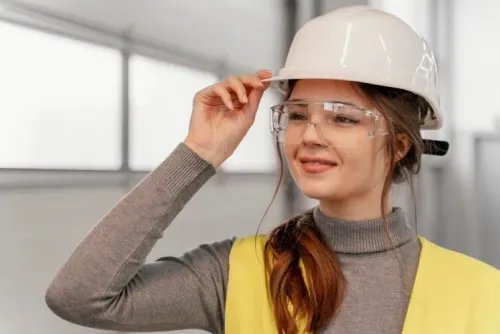
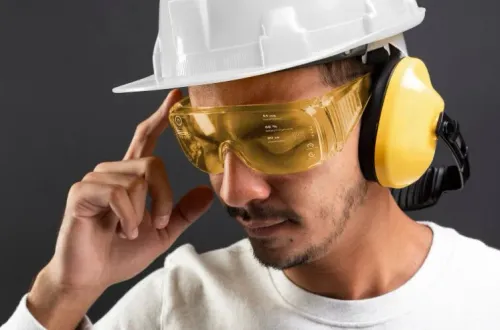
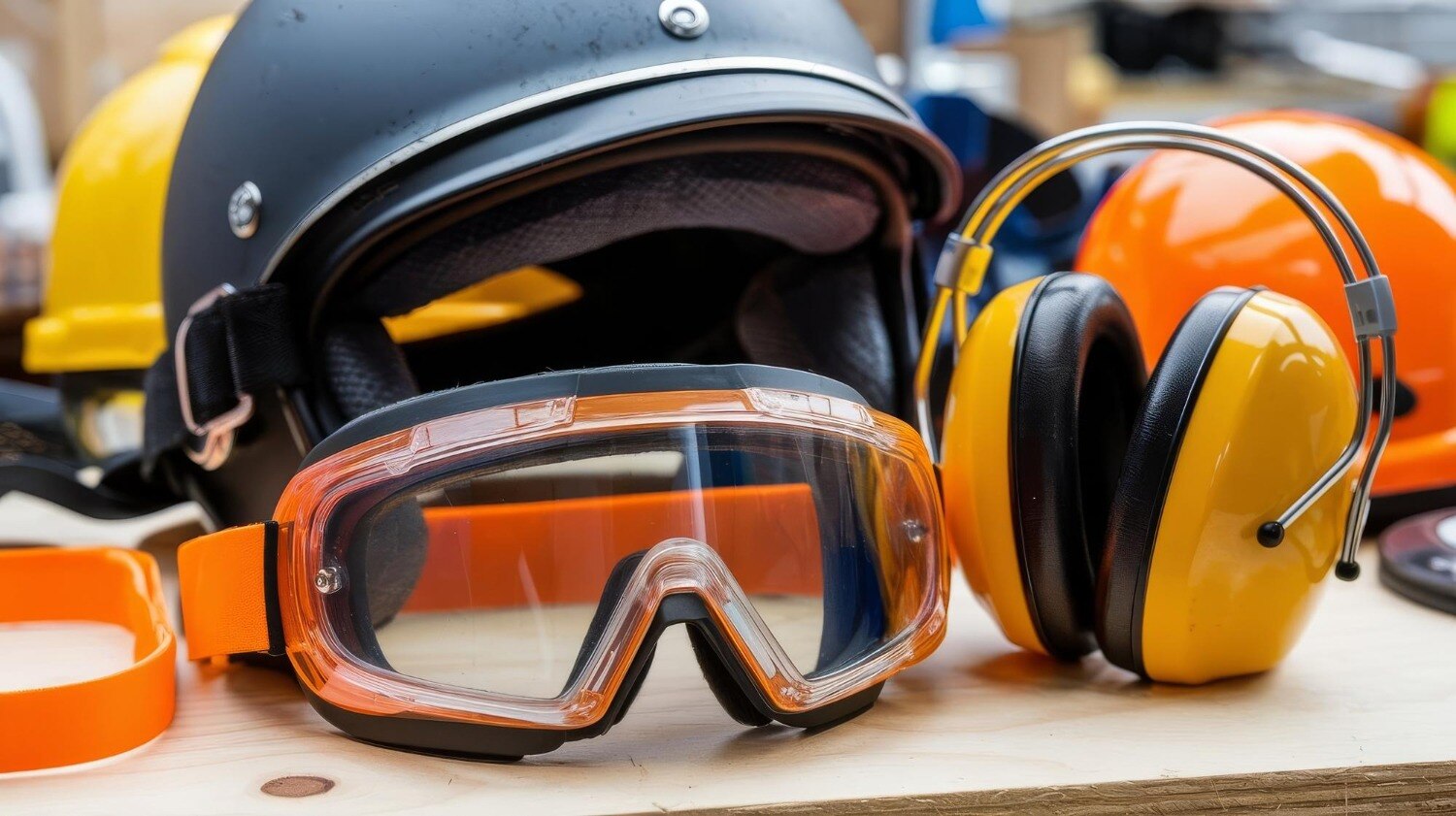
Test virtual protective eyewear and ear safety products as one system, not as separate catalogue items. Wear the helmet, eyewear, hearing protection, and communication device for the full exposure period while performing the movements and tasks required on site.
- Check that spectacle temples do not lift the earmuff cushions away from the head. Try low-profile temples and earplugs if the seal breaks.
- Fit goggle straps beneath or around the helmet as designed. Reject any arrangement that twists the strap, shifts the goggles, or leaves a gap at the face.
- Adjust the helmet without forcing its suspension against the goggle frame, strap, or earmuff attachments. Mark pressure points on the forehead, ears, nose, and temples after extended wear.
- Test anti-fog performance during walking, bending, heat, and humid work. Fog that returns after a few minutes is a visibility failure, not a minor inconvenience.
- Operate the radio or headset with the chosen eyewear, helmet, and hearing protection. Confirm that controls remain reachable and the microphone does not move when the wearer turns.
- Have a supervisor give the site alarm from the normal working position. The wearer must detect and understand it without removing ear safety products or lifting the eyewear.
Repeat the trial after sweating and after cleaning the cushions, straps, and lenses. A combination that becomes painful, fogged, loose, or acoustically isolating will be adjusted or removed before issue. Document the approved combination and the wearer’s fit check.
Build a Wholesale Specification and Verify Each Wearer’s Fit
Put the acceptance criteria into the purchase order, not a later toolbox talk. For safety goggles for wholesale, require the applicable standard, manufacturer and model, lens or filter marking, impact rating, optical class, sizes, spare parts, and instructions for cleaning and replacement. Specify industrial eye protection by hazard, not by product name.
1. Ask the supplier to confirm every marking on the product and packaging, including ANSI/ISEA Z87.1 where applicable and the high-impact “+” designation. Treat virtual protective eyewear and ear safety products as separate specifications; a digital try-on or product label does not replace physically certified protection.
2. At issue, inspect each lens, frame, strap, gasket, cushion, plug, and band. Reject cracked lenses, distorted vision, hardened seals, contaminated plugs, stretched bands, or missing identification.
3. Have each wearer adjust the eyewear until it sits securely without a pressure point. Confirm that prescription users have prescription safety spectacles, compatible inserts, or over-the-glasses goggles—not ordinary glasses beneath sealed protection.
4. Train the wearer to roll and insert each earplug, then check seating by asking about looseness and voice reduction. For earmuffs, reposition hair, helmet edges, and spectacle arms so the cushion contacts skin continuously; use individual earplug fit-testing where the hearing programme requires measured attenuation.
5. Record issue date, cleaning method, storage location, inspection frequency, and replacement triggers. Replace disposable plugs after contamination, and replace eyewear or earmuff parts when damaged or when seals no longer recover.
AI Sales Corporation can support a Pune buyer by documenting these model-level details before an order is released.
Related products
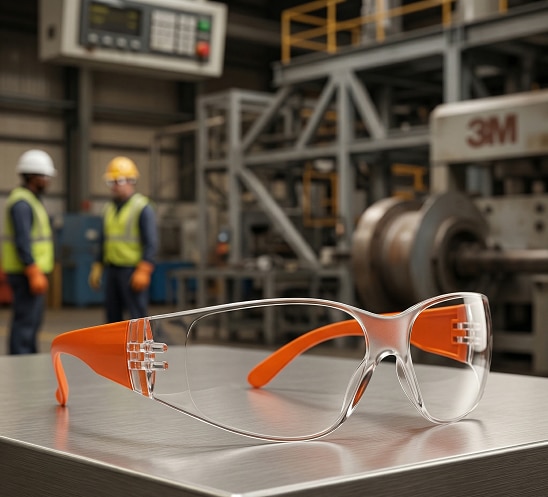 | Safety Goggles Advanced Eye Safety Solutions by AI Sales Corporation, Pune AI Sales Corporation, based in Pune, presents high-quality Virtual Protective Eyewear... View product → |
 | Safety Goggles Honeywell A700-AF Safety Spectacles Premium Eye Protection by AI Sales Corporation, Pune Protect your eyes with the high-performance Honeywell A700-AF Safety Spectacles, designed for... View product → |
Frequently asked questions
What does “virtual protective eyewear” mean?
Treat the label as undefined until you identify the product’s physical function. It can describe a virtual try-on tool, digital selection feature, augmented-reality or virtual-reality hardware, or real industrial eyewear.
How do you match industrial eye protection to a hazard?
Identify the hazard first, then check the eyewear construction and markings for the required impact, splash, dust, chemical, radiation, or other protection.
How should you choose ear safety products?
Start with measured noise exposure and compare the product’s attenuation data, such as NRR or SNR, with the required protection. Select earplugs, earmuffs, or both based on the work conditions and fit.
Why test eyewear, hearing protection, helmets, and communication systems together?
One item can interfere with another by breaking seals, reducing visibility, creating pressure points, or blocking communication. Test the complete combination on the intended wearer before wholesale approval.
Keywords